
State Executive Director Duncan Johnson Jr. on the disaster money still open, what changed in the Tree Assistance Program for 2026, and why an unreported acre costs more than growers realize.
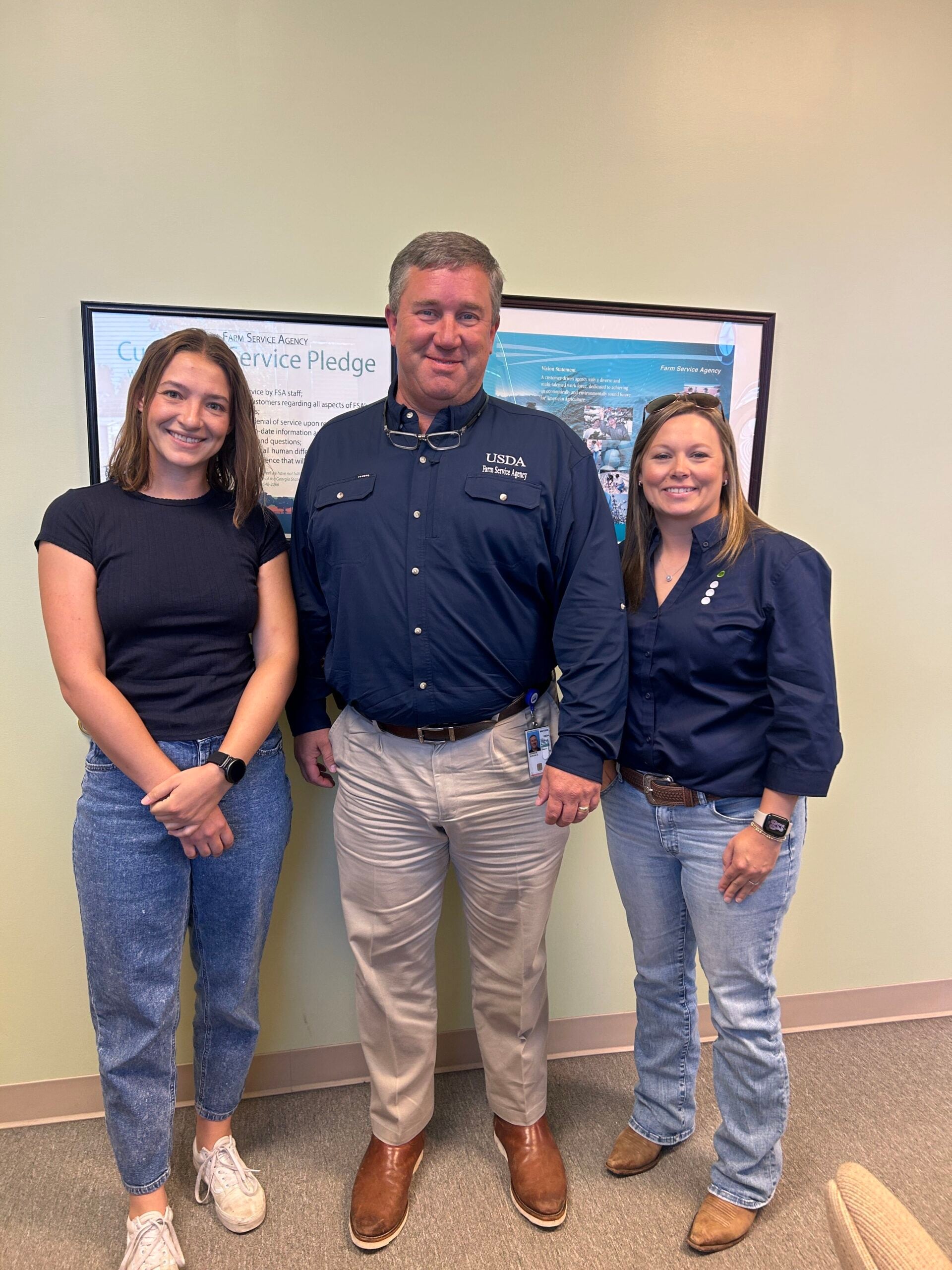
State Executive Director Duncan Johnson Jr. with Erica Cannon and Kayla Huffman, Insure.ag
Ask Duncan Johnson Jr. what he is hearing as he travels Georgia and you get a reminder of how much state there is to cover.
“We were hearing a lot of drought in North Georgia and struggling with that. And now they’re flooding in North Georgia,” says Georgia’s State Executive Director for the USDA Farm Service Agency. “And South Georgia has had a lot of rain, and now they’re entering a drought.”
That whiplash is the backdrop to a run of years Georgia growers have not had a chance to catch their breath from, including two hurricanes six years apart, wildfires people are still recovering from, and drought designations across much of the state. But the conversation Johnson keeps returning to is not about weather. It is about paperwork, and specifically about the growers who are eligible for help and often never claim it.
The thread running through everything, he says, is that FSA can only act on what it can see. Programs are designed from reported data, applications are generated from records already on file, and a grower who is not in the system is not in the calculation.
The Money Is Still On The Table
If you have only ever dealt with FSA to file an acreage report, this is the part worth knowing: the agency also runs disaster programs that sit alongside your insurance policy rather than replacing it. They do not pay out automatically. You apply, and each one closes on a fixed date.
The most immediate item is the Supplemental Disaster Relief Program, which covers revenue, quality and production losses from weather events in the 2023 and 2024 crop years. This is the window that includes Hurricane Helene.
“There are SDRP 1 and 2. Both are open,” Johnson says. “We extended it to help folks, and it goes through September 30th.”
Stage 1 is built on crop insurance and NAP data for growers who already had an indemnified loss. Stage 2 covers what Stage 1 does not: shallow losses that never triggered an indemnity, uninsured crops, and quality losses. It is the stage growers most often do not know exists.
When USDA extended the deadline in August, it added two flexibilities that matter disproportionately for specialty crops. Growers can now use verifiable and reliable documentation to establish a quality loss. And where a crop ended up in a different market than the one it was grown for, for example fresh-market fruit that went for processing, that difference can be claimed as a quality loss percentage.
Both flexibilities come with a documentation standard. For quality losses, FSA asks for third-party verifiable documentation of grading factors or nutrient tests alongside acceptable production records, and the tests should be dated within 30 days of harvest, though county committees can accept later tests that still represent the crop’s condition at harvest. For a crop that went to a different market, it is production records showing actual production and the price received. Growers who kept packhouse tickets and settlement sheets are in better shape here than they may assume.
Both stages close on 30 September 2026.
The prerequisite for most of it is the same thing Johnson keeps coming back to: “Most of that is based off of your acreage reporting,” he says. “It’s one of the most important things you can do.”
One thing worth flagging: FSA was not able to generate a Stage 1 application for every eligible grower, because in some cases the production data on file was incomplete. Those growers are still eligible and still have to apply by the deadline. If you had an indemnified loss in 2023 or 2024 and never heard anything, it is worth following up.
What Changed For Orchards
For pecan, blueberry and other tree, bush and vine operations, the Tree Assistance Program looks materially different this year, and the changes favor growers with partial losses.
Every orchard loses some trees in a normal year, and TAP has never paid for those. There is a baseline figure for normal mortality that varies by commodity and by area, worked out largely through UGA Extension. Under the old rules a grower had to clear that baseline and then lose a further 15% of the block before a single tree became eligible.
That extra 15% is now gone. In FSA’s own wording, losses in excess of normal mortality from eligible adverse events are eligible for assistance, beginning with the 2026 program year and applied retroactively to 1 January 2026.
“That was always a pretty big burden to overcome,” Johnson says. “That’s been eliminated. So that was a huge help.”
TAP is not income replacement. It pays toward the cost of replanting and of saving the trees you can save, which is why the cost-share percentage matters as much as the threshold.
Two other changes matter. USDA now covers 65% of the cost of pruning, removal and other work to salvage existing trees or prepare ground for replanting, up from 50%. On a $10,000 job, that is $6,500 back instead of $5,000. Beginning, limited-resource and socially disadvantaged farmers can receive up to 75%. And growers have 24 months to finish the work instead of 12, counted from the date the application is approved, with the option to request an extension to 36 months where delays are outside their control.
Johnson points to blueberries as the reason the timing change was needed. Growers were required to replant within 12 months at moments when the plants simply were not available to buy. “So instead of having to go back and ask for an extension, which would have been granted, thank goodness. Now you’ve got 24 months, which is a more reasonable time,” he says.
“That program’s huge, and it’s going to be really important to our specialty crop folks, more so than anything else.”
The Number That Isn’t There
Johnson’s central argument is that specialty crop growers in Georgia are under-counted, and that the under-counting costs them.
Specialty crop growers, Johnson says, have historically been less likely to file acreage reports than growers of traditional row crops.
The clearest illustration he offers is citrus, a crop expanding quickly in south Georgia. Johnson is in regular contact with the people who run Georgia’s commodity organizations, and when he sets their citrus acreage against FSA’s, the two are, in his words, “nowhere near.” The reason is that those acres have never been reported.
The consequence is not abstract. Program design, and the case for extending programs to a state or a commodity, runs on reported data.
“So much of what we do is the data,” he says. “The more data you have, the better you are at making your decisions and knowing what’s needed to help.” When he takes Georgia’s numbers to Washington, the argument that citrus is growing here, and that the state needs programs to match, is only as strong as the acreage reports behind it.
“It’s easy with the traditional crops, because you’ve got such a history,” he says. “The ones that aren’t as old, or don’t have the history, having those reports is huge.”
Reporting From The Seat Of The Tractor
The practical barrier to acreage reporting has been the trip into the office, and that barrier is now coming down. In June, USDA launched a pilot that moves acreage reporting off paper maps and onto an electronic interface, part of a wider effort the department calls One Farmer, One File. Tift County is Georgia’s pilot county, one of eleven pilot areas nationally, alongside every county in Maryland and North Dakota. Johnson says the choice was deliberate: if the system could handle the complexity of specialty crop acreage in Tift, it could handle the rest of the country.
A grower can now finish planting and file from the field, splitting a field into sections or mapping a single pivot circle on the screen, and export or import field boundaries as shapefiles through the farmers.gov portal.
There is a second route that specialty crop growers in particular tend not to know about. A geospatial acreage report can be filed through an approved insurance provider or an authorized third party, who then shares the file with FSA. This is one report, satisfying both the agency and the policy, rather than the same field drawn twice.
“If you do your acreage report when you’re pulling out of the field, you don’t have to remember it later,” Johnson says. He explains, “Most farmers I know, their filing system is the dashboard of their truck.”
It is reasonable to ask whether moving a government process onto a phone leaves some growers behind. USDA’s most recent survey of farm technology suggests the equipment is not usually the sticking point. Eighty-four percent of Georgia farms reported having a smartphone, and 90% reported internet access.
Johnson’s own answer to the question is about the system rather than the grower. He came to FSA with no agricultural background at all, and had never set foot in an FSA office until he took the job a year and a half ago.
“Me having no ag background when I started, I can work the system. So, I kind of use myself as the baseline. If I can do it, you can do it.”
County offices will sit down and walk a grower through it. And the time saved changes what an office visit is for. “You don’t have to spend an hour and a half doing acreage reporting. You can actually talk about the programs,” Johnson says. “It helps our staff be more of a concierge than if we are just a secretary doing the paperwork.”
The longer-term aim of One Farmer, One File is a single record that follows a grower across USDA (FSA, NRCS and RMA) working from the same file tied to a farm number, rather than a grower updating maps at FSA and walking across the hall to redo the same work at NRCS. Johnson expects full rollout by the end of 2028.
Everything runs through a login.gov account, the federal government’s shared sign-in service. It takes three pieces to set up: the account, an identity check done online or at a service center, and a USDA customer record, which can take seven to ten business days for anyone not already on FSA’s books. That lead time is the reason the advice has a deadline attached to it.
Asked for the single thing he would have every specialty crop grower in Georgia do before the end of the year, Johnson names it ahead of everything else, acreage reporting included.
“Create a login.gov account. That is huge.”
For Growers Just Starting Out
Georgia has more new farmers than almost anywhere in the country. At the last agricultural census, 23,085 Georgians, 34.4% of the state’s producers, seventh-highest share in the United States, had ten years or less of experience. They are not, for the most part, young: the average beginning farmer in America is 47.
FSA’s response runs through credit: farm storage facility loans, operating capital, and guaranteed loans made through a commercial bank with FSA standing behind them.
Johnson is a particular advocate for the guarantee route, and the reason is relational rather than financial. “You can get a relationship with a local bank that you’re going to need later on,” he says. “History has proven that in farming.”
Alongside the lending there is a quieter service, which Johnson describes as helping new growers find the sequence of things. “It isn’t just going and tearing up the dirt and throwing some seeds,” he says. “It’s all the stuff around it.”
It is also worth knowing that beginning farmer status is not only a lending category. It is the same status that lifts the TAP cost share from 65% to 75%.
The Elections Nobody Runs In
Asked what growers most need to hear that nobody asks him about, Johnson does not hesitate.
FSA county committees are elected by the farmers in their area, and they carry real weight over how programs are administered locally. Turnout and candidacy are both thin.
“If they don’t represent themselves, if they don’t make sure that somebody who thinks like a farmer does is on those county committees, you get what you get,” he says. “And that’s a lot of the issues that we deal with; the inconsistency of county committees.”
That inconsistency is not theoretical, and it connects back to the disaster programs. It is a county committee that decides whether to accept a quality test taken more than 30 days after harvest. Who sits on it is the difference between a claim that works and one that does not.
He puts the elections on a level growers may not expect. They are, he says, “just about as important as for every other state office and national office. It’s a big deal in our world. And people have just kind of stepped away from the process.”
One historical reason for stepping away has largely resolved itself. Committee service used to mean your own payments moved more slowly, because the state committee had to approve them. Johnson offers the Hurricane Helene cleanup as evidence of how much the processing has sped up: the Emergency Conservation Program, he says, has moved from just over 9,000 applications down to 318 outstanding, distributing $255 million in the past year.
“We’re moving the needle,” he says.
What He Actually Wants Growers to Believe
Johnson knows the line that precedes him. “You hear ‘we’re from the government, we’re here to help,’ and everybody gets skeptical and scared,” he says.
His answer is to describe the job in terms of risk rather than rules. “We take a lot of the risk out of farming,” he says. “What we do is hopefully provide the courage and ability for people to take risks.”
He is also clear about where the agency’s work stops. Asked how FSA and federal crop insurance fit together, he describes them as complementary rather than overlapping, and neither as a competitor to the private sector.
“None of us are in competition with any private business. We’re there to subsidize it, we’re there to help it, to make it work to where it’s a good business,” he says. “I would love for farmers not to need the government at all. And I think farmers would like that too.”
There is one more thing he wants growers to know: Any grower can file a power of attorney form at their county office authorizing someone, including an agent, a family member, a farm manager, to discuss their farm with FSA on their behalf.
“It’s like going to the doctor and saying who can you share your medical information with,” Johnson says. “If you’re not getting your clients to fill that out at the FSA office, you need to get them to do that.”
It is a small form, and it reinforces the same argument: The growers who get helped are the ones the agency can see, and can talk to, before the deadline rather than after it.
Before The End Of The Year
Four things, drawn from the conversation:
Create a login.gov account. It is the key to the electronic acreage reporting system and, increasingly, to everything else. Allow seven to ten business days if you are not already on FSA’s books.
File your acreage report. It gates most disaster programs, and in aggregate it is the argument for bringing more programs to Georgia. It can be filed through an approved insurance provider as well as at the county office.
If you had a 2023 or 2024 loss, check SDRP before 30 September. Stage 2 in particular covers shallow and quality losses that never triggered an indemnity, including crops that had to be sold into a different market than intended.
If you have trees, bushes or vines, look again at TAP. The 15% mortality threshold is gone; the cost share is 65% — 75% for beginning and limited-resource growers — and you have 24 months to complete the work.
Your county FSA office will tell you what to bring before you drive over. Johnson’s advice is simply to call and ask.
Insure.ag is a crop insurance agency working with growers in Georgia, Washington and California. This interview was arranged through the Georgia FSA State Office, and FSA reviewed this article for accuracy before publication. Nothing in it is a recommendation of any specific coverage.