
Federal crop insurance runs on a yearly rhythm. Here are the 13 steps of the cycle, what happens at each one, and what your agent handles with you along the way.
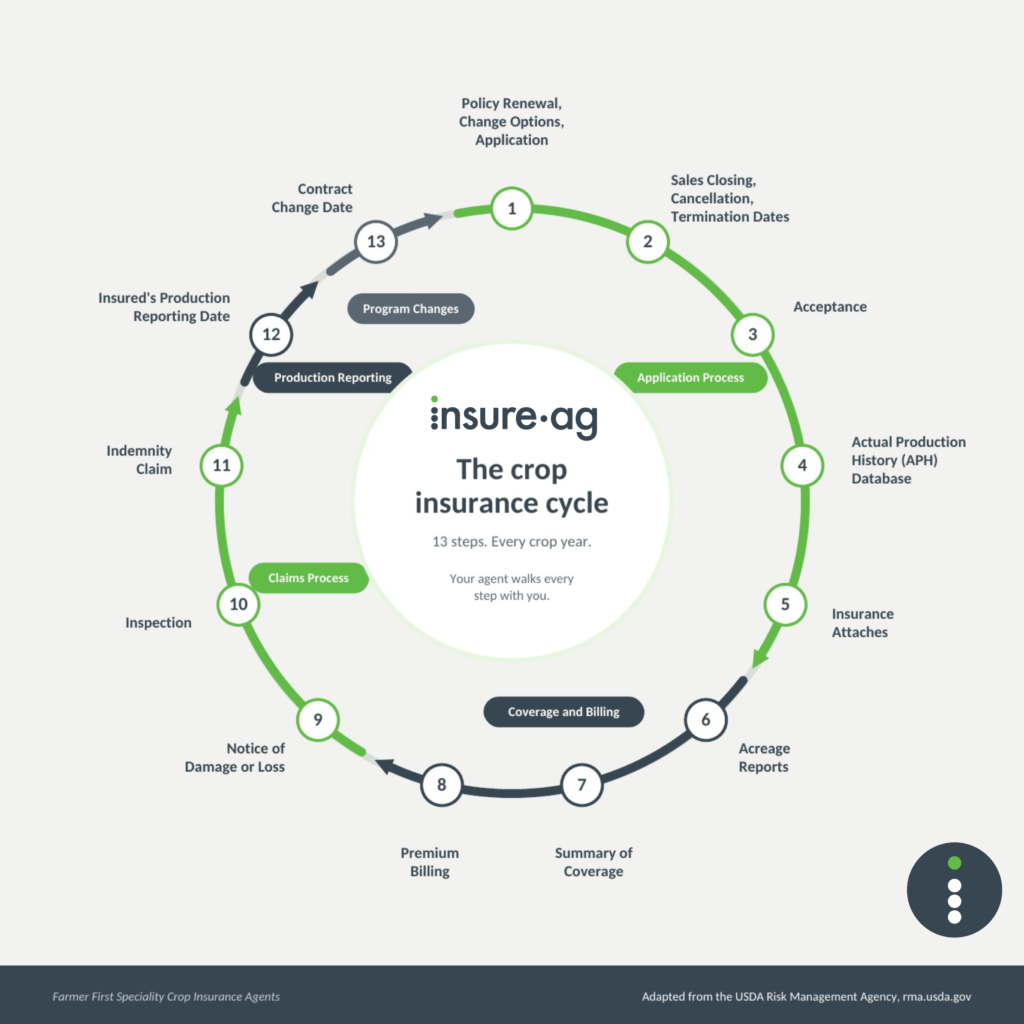
Federal crop insurance runs on a yearly rhythm. Here are the 13 steps of the cycle, what happens at each one, and what your agent handles with you along the way.
Phase 1: Application process
Getting the right coverage in place before the season starts.
- Review your options. USDA’s Risk Management Agency (RMA) publishes what can be insured in your county each year: crops, practices, coverage levels, and prices. You have several months to sit down with your agent and build a risk management strategy that fits your operation.
- Sales closing date. The deadline that matters most. Applications and any coverage changes must be signed by this date. Existing policies renew automatically each year unless you cancel in writing by the cancellation date.
- Acceptance. Your insurance provider processes the application and sends your policy documents. Once accepted, the policy is locked in for that first crop year.
- Production history (APH). Your yield records from prior years (4 to 10 of them) set your approved yield, the foundation of your guarantee. Short on history? Transitional yields fill the gap until your own records take over.
- Insurance attaches. Coverage begins at planting for annual crops, or on a set calendar date for perennials like tree fruit. Can’t plant because of an insured cause? Prevented planting coverage may apply.
Phase 2: Coverage and billing
Telling your provider what you planted, and what it costs to protect it.
- Acreage report. Report what you planted, when, where, your share, and your practices by the acreage reporting date. This report sets your coverage amount and premium, so accuracy matters. Late reports can mean denied coverage.
- Summary of coverage. Your provider confirms your insured crop, acres, and guarantee for each unit. Review it with your agent and flag anything that looks off.
- Premium billing. Your bill arrives based on the acreage report, no earlier than the billing date in your policy. Payment plans are available, and unpaid balances accrue interest, so talk to us early if cash flow is tight.
Phase 3: Claims process
When weather or markets hit, this is how coverage turns into a check.
- Notice of loss. Found damage? File a notice of loss within 72 hours of discovering it, and no later than 15 days after the insurance period ends. Call your agent first; we handle the filing.
- Inspection. A loss adjuster inspects the damage and documents the loss. Important: don’t destroy or abandon the crop before the adjuster has seen it and given the go-ahead.
- Indemnity payment. If a payment is due, the provider issues your indemnity check along with a summary showing any deductions for outstanding premium or fees.
The 72-hour rule: that’s your window to report damage after you first discover it. When in doubt, report. It’s far easier to withdraw a notice of loss than to file one late.
Phase 4: Production reporting
Closing out this year’s records to set up next year’s guarantee.
- Production report. Report this year’s production by your production reporting date. These numbers feed your APH database and set your approved yield, and your guarantee, for next season.
Phase 5: Program changes
How the program improves from one year to the next.
- Contract change date. RMA updates policies year to year based on producer feedback. Changes post by the contract change date, and your provider notifies you at least 30 days before your cancellation date. Review them with your agent, then keep, change, or cancel your coverage.
Then it starts again. The crop insurance cycle rolls straight into next year’s insurance offer. Since policies renew automatically, it’s worth sitting down with your agent each year to make sure your coverage still fits your operation before it rolls over.
Download the full cycle as a printable PDF:
Keep it on the shop wall, in the truck, or wherever you plan your season.
Questions about any step? That’s what we’re here for. Call (512) 222 6978 or email connect@insure.ag.
Insure.ag, Farmer First Speciality Crop Insurance Agents
Source: USDA Risk Management Agency, Insurance Cycle. Simplified for readability; your policy’s Crop Provisions and Special Provisions govern.