
How a farm broadcaster and a former Bloomberg ag reporter are telling agriculture’s story in ten minutes or less, and what growers can learn from them.
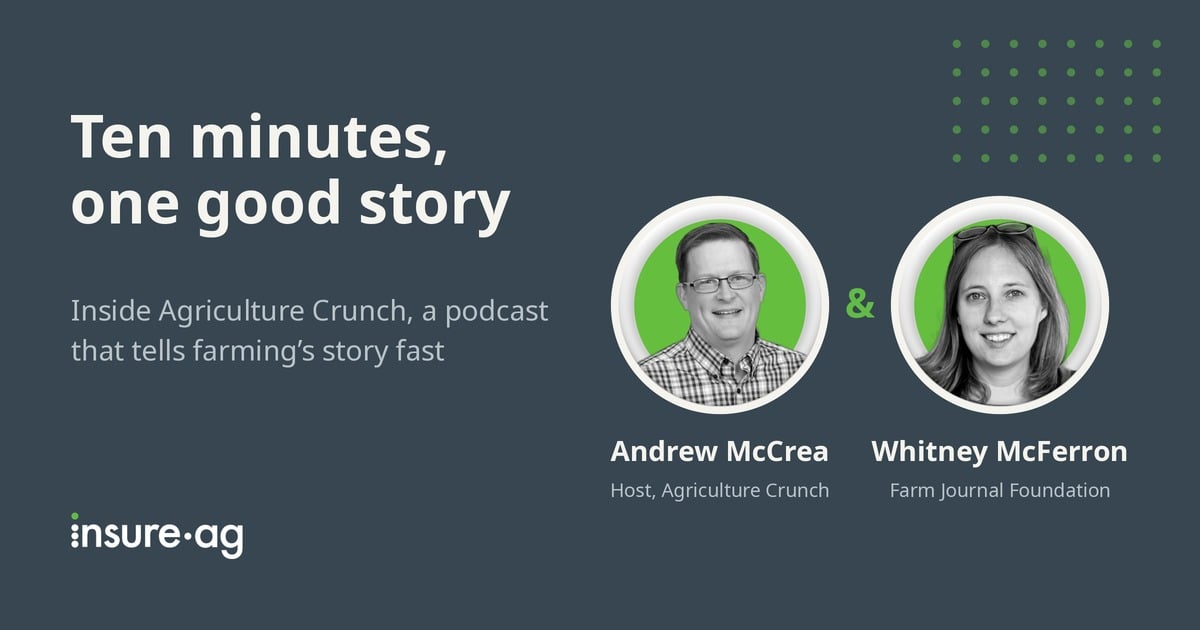
Andrew McCrea took our call from the cab of a tractor. It was mid-October, harvest was on in northwest Missouri, and a grain wagon was hitched behind him, waiting to be loaded. “If I get busy here for a moment, I may turn the camera off,” he said. Then he settled in and talked for half an hour about how to tell a good story fast.
It was a fitting scene. McCrea and Whitney McFerron of Farm Journal Foundation make a podcast built on a simple rule: say something worth hearing, then stop. We asked them how they inform and entertain an audience in an age of information overload, and keep it sharp and to the point.
Meet the team behind Agriculture Crunch
Agriculture Crunch launched on August 19, 2026, from Farm Journal Foundation and Farm Journal Media. Episodes run about 10 minutes and come out monthly, on video and audio.
Andrew McCrea is the host. He farms and ranches near Maysville, Missouri, on the land where he grew up, and his dad, 83, and his son, now studying agriculture, are part of the same story. McCrea was a National FFA officer in 1993–94, then started The American Countryside in 1996 as a weekly feature on KFEQ radio in St. Joseph. It grew into a daily syndicated show with interviews from all 50 states and six continents. He joined Farm Journal in 2013 and also hosts the weekly Farming the Countryside podcast.
Whitney McFerron runs communications for Farm Journal Foundation, the nonprofit sister organization to Farm Journal’s media business. She grew up in southeast Missouri, where her dad, uncle and grandfather farmed together. She covered agriculture for Bloomberg for about eight years before joining the Foundation five years ago.
Both started out as journalists, and it shows in how they work and in what they make.
It started with a garden on the National Mall
The podcast grew out of the Foundation’s Voice of the Farmer Garden, outside USDA headquarters in Washington. The Foundation partnered with USDA on it in 2019 to show visitors how food travels from seed to table.
“We’re kind of front and center there on America’s front yard,” McFerron said. Corn, soybeans and wheat grow beside pollinator plants and vegetables, a short walk from the Smithsonian. Signs and a phone walking tour, narrated by farmers, explain what’s growing and why.
The question was how to take that lesson beyond the people who walk past. The answer was a podcast for two audiences: Farm Journal’s farm listeners, and people who simply want to know where their food comes from. The first episodes covered insects with Western Growers’ Jeana Cadby, livestock exporting with Florida cattle producer Renee Strickland, and the farm bill with the Foundation’s Dr. Stephanie Mercier.
Why ten minutes works
Most farm podcasts and radio segments run 30 minutes to an hour. Agriculture Crunch is built for people on the go who want to learn one thing well. “We’re all in a period of maybe shorter attention spans than we used to have,” McFerron said.
McCrea, who still times radio segments to the second, thinks the limit makes the show better. “A lot of people that do podcasts say, well, I have no time limit, so I can just talk as long as I want to,” he said. “That’s sometimes not a great show because it gets too loose and it rambles. I still like having time limits. It just makes things better.”
His secret is the pre-interview. Journalists usually keep questions back to keep answers fresh. With guests who aren’t used to a microphone, McCrea does the opposite: he shares the topics and the end goal ahead of time, so nothing surprises them. “We’ve only got 10 minutes, we want to ping back and forth, so don’t try to get everything in one answer.”
The result isn’t scripted, McFerron said, but it is organized. “They walk away with a theme in their mind.”
What listeners are choosing
The show is young, but one early signal stands out. On YouTube, the most-watched episode so far is the farm bill explainer. It didn’t chase the latest news from Washington. It stepped back and asked what the farm bill actually is.
“Everybody’s heard about the Farm Bill, but what’s really in it?” McFerron said. The episodes are meant to have a shelf life, so people can come back to them.
McCrea has also learned that one guest can carry two very different stories. A recent episode on rice is a good example. For curious consumers, it’s an introduction to a crop grown in only a few regions. For farmers, the angle he’d take on Farming the Countryside is different: rice is one of the crops where every grain grown in the U.S. can be tracked, and that has lessons for everyone else.
Video is the other surprise. “It’s just two people on a screen talking,” McCrea said, but YouTube numbers for his shows have rocketed. His dad still prefers the radio. His son listens on his phone. “Radio is not dead,” he said. “But there’s some folks that will only watch YouTube or see it on LinkedIn, and it’s important to hit those folks too.”
A public that wants to know more
Both see an opening for agriculture right now. “Farmers in the US represent less than 2% of the population today,” McFerron said, “but everybody eats. We’re all connected to agriculture, whether we ever think about it or not.”
More people are asking where their food comes from and what’s in it, helped along by movements like Make America Healthy Again. Some commodities see that as an opportunity, some less so. Either way, misinformation travels fast. “This is what agriculture has to say about agriculture,” McFerron said. “That’s important for people within agriculture and important for consumers to hear.”
On the farm, McCrea sees the same shift from the inside: sustainability and closer ties to consumers matter more each year, because farmers can now be paid for some of their practices and the technology exists to pass that information through the food system.
The one habit McCrea recommends
Before we hung up, McCrea offered a piece of advice for every grower and agent with a story worth telling: write it down, or film it, the moment you see it.
“People always say, oh, I’ll remember that,” he said. “Well, you don’t a lot of times.” Even after 30 years in broadcasting, he still keeps a running list of story ideas. “Even if they’re just taking pictures or video on their phones, maybe it’s something that’s used in social media, maybe it isn’t, but at least they’ve documented that so somebody could come back later on and talk with that farmer or that grower.”
It’s advice we’re taking to heart at Insure.ag. Our agents sit with specialty crop growers in Washington, California and Georgia every week, and the best stories in agriculture rarely announce themselves.
Listen to Agriculture Crunch
New episodes come out monthly on YouTube, Farm Journal TV, Farm Journal NOW on AgWeb and major podcast apps. If you’re in Washington, D.C., visit the Voice of the Farmer Garden outside USDA headquarters on the National Mall, open to the public year-round.
Have a story idea for the show? The team is booking guests through the end of fall. Get in touch with us and we’ll pass it along.
Sources
- Interview with Andrew McCrea and Whitney McFerron, October 14, 2026
- Farm Journal Foundation: New “Agriculture Crunch” podcast tells stories about food and farming
- AgWired: New “Agriculture Crunch” podcast from Farm Journal
- NAFB: American Countryside celebrates 20 years
- NAFB: McCrea follows his passion
- American Countryside: About Andrew McCrea
- Farm Journal: Foundation partners with USDA (2019)