
A microbe that lives in boiling acid shouldn’t have anything to do with your orchard. It might be about to change how growers fight fire blight and Listeria.
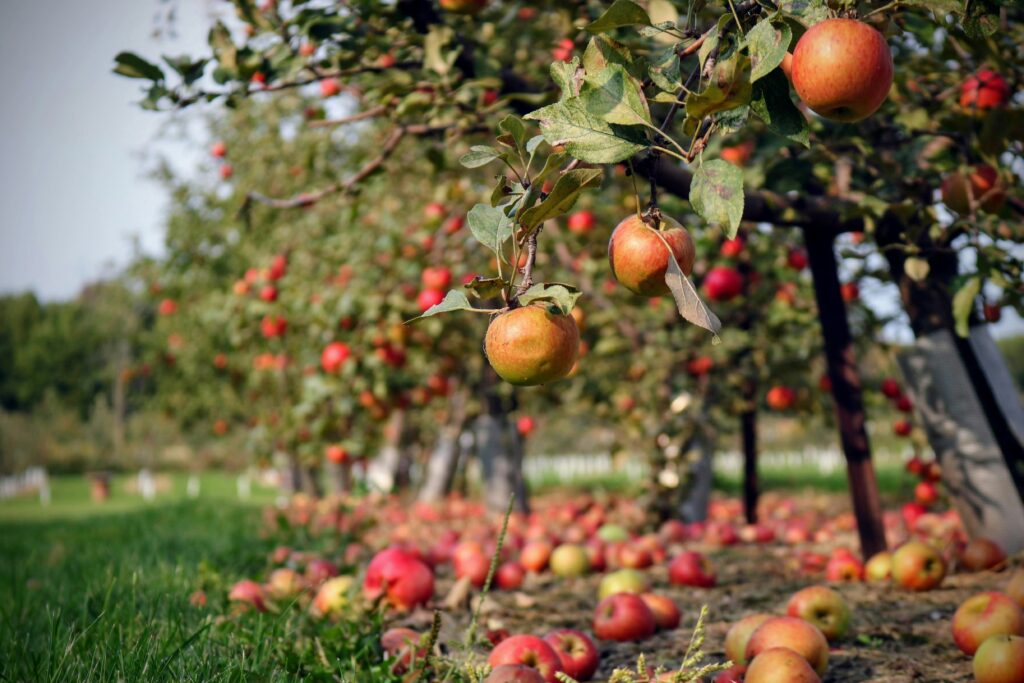
Fire blight can take a tree down to the roots. One infected branch, a few warm wet days during bloom, and an insect to carry it and a healthy block starts dying limb by limb. Nationwide, the disease costs the industry more than $100 million a year. For Washington, a state that grows nearly two-thirds of the country’s apples, fire blight isn’t a nuisance. It can wipe out an entire orchard.
For decades, the answer has been antibiotic streptomycin and copper sprays. But streptomycin is losing its punch as the bacteria learn to shrug it off, and copper brings environmental baggage of its own. The tools are wearing out. The pathogens aren’t.
The good news is that the next defense might come from a microbe that lives where almost nothing can.
“We asked the microbe what it made”
Cynthia Haseltine, an associate professor at Washington State University, is a microbiologist who has spent more than 30 years studying archaea, an ancient, strange branch of life that thrives in boiling acid, deep-sea hydrothermal vents, and salt crystals. Forms of life that, in her words, “really shouldn’t exist in a lot of the places they do.”
For most of that time, fighting fire blight was nowhere on her radar. Her lab studies how these extreme microbes survive when their DNA should fall apart. The discovery that’s now headed into Washington orchards started as a side project and a hunch.
“We turned and looked at the microbe and asked the microbe what it made,” Haseltine said. The team broke the organism into its component parts and tested each one against a range of harmful bacteria: could it kill them, or not? After years of trial and error, one compound kept working. And it worked against two of the most expensive problems in the fruit business at once: the bacterium behind fire blight, and Listeria.
Why this one is harder to outsmart
Bacteria are relentless, as well as clever.
“Microbes are really smart,” Haseltine explained. “They’re very clever.” That cleverness is exactly the problem with traditional antibiotics: an antibiotic is a small molecule, and often a single mutation is all it takes for a microbe to slip past it. It’s why streptomycin, the longtime fire blight treatment, keeps losing ground.
This compound works differently. To survive it, a microbe would need several mutations to land at the same time. This is very unlikely. “There’s a really low chance for resistance developing,” she said.
It has two more things going for it. It stays stable across a wide range of temperatures, including hot afternoons in the orchard, cold packing lines indoors, and it stores well at room temperature. It also works on bacteria hiding inside biofilms, the slimy protective layers that let Listeria lurk in the corners and crevices of packing equipment where disinfectants can’t reach.
What it could look like on your operation
It is still very early days, Haseltine emphasized. She added, “There’s a lot that has to go right.” But the picture is taking shape.
For fire blight, the compound would likely be sprayed during bloom, the same window growers already treat with antibiotics and copper. It may eventually be combined with other tools to hit the disease harder. For Listeria, it would most likely work as a surface treatment or sanitizer on packing-line equipment such as brushes or flumes, the spots contamination loves to hide.
The point that should matter most to growers: it’s designed to slot into what you already do. Because it’s stable and stores easily, Haseltine expects it “could make it fairly easy to fit this into existing equipment and routines that are already in place without major changes.”
Why agents should be paying attention
For crop insurance agents, this is a risk story before it’s a science story. Fire blight is a top driver of tree-fruit loss, and Listeria turns a clean harvest into a recall — and a recall can run $5 to $15 million, on top of unsellable fruit and a bruised reputation. Washington only sees 10 to 25 Listeria cases a year, but each one can be financially brutal.
A tool that meaningfully lowers either risk changes the conversation you have with growers about exposure, about loss history, about what “well-managed” looks like a few seasons from now. Worth tracking, not because it changes anything this year, but because it could reshape the risk picture down the line.
How far away is it?
Real, but not tomorrow. The work is backed by a grant from the Washington Tree Fruit Research Commission, money funded directly by growers, for a two-year project to scale up production, test stability, and run the first orchard and packing-line trials.
It’s already in the field. The compound is being applied to trees in Wenatchee with WSU Extension tree-fruit specialist Tianna DuPont, while food-safety expert Claire Murphy in Prosser supplies real Listeria isolates pulled from actual outbreaks. Packing-line testing may move faster than the orchard work, since it isn’t bound by the growing season.
As for a launch, Haseltine explained that it’s too early to put a firm date on it, but she said, “We’re hopeful we’ll have clearer answers in the next couple of years.” The goal is enough hard data to attract a commercial partner who can make the compound at scale.
What excites her most isn’t even this one compound. It’s the door it opens. “Now that we found one, I think we know what we’re looking for,” she said. “There’s more out there that we have yet to discover.”
A bug that eats acid, pointed at the bugs that eat your bottom line. Strange. Promising. And worth watching closely.
At Insure.ag, we keep an eye on what’s coming for the crops you grow so you’re never the last to know. Farmer First Specialty Crop Insurance Agents.
Researchers or industry partners interested in the compound can reach WSU’s innovation team at innovation@wsu.edu. Research credit: Cynthia Haseltine, Associate Professor, WSU College of Veterinary Medicine’s School of Molecular Biosciences. Reporting drawn from WSU Insider and a June 2026 interview with Cynthia Haseltine.