
Inside California Association of Winegrape Growers (CAWG’s) collaborative push to build better risk tools, protect American-grown fruit, and prove that an industry built on generations doesn’t go quietly.
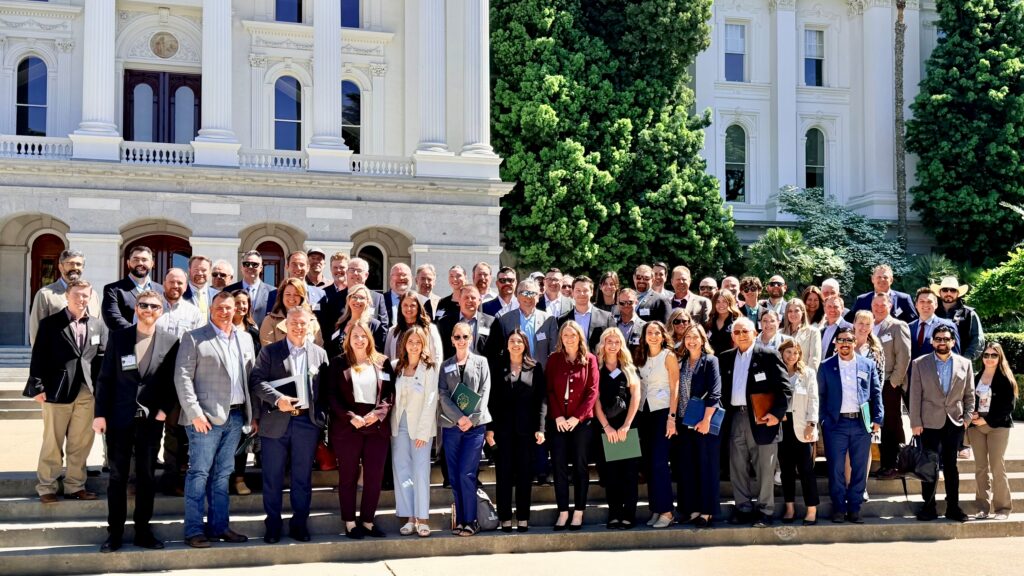
California produces about 80% of all American wine. Roughly 477,000 acres of vineyards. Around 2.8 million tons of grapes are crushed each year. Behind every one of those numbers is a grower, and increasingly, a community that’s choosing to face a difficult market together.
Natalie Collins sees that community up close every day. As President of the California Association of Winegrape Growers (CAWG), she works alongside a 27-member board of directors that spans small family growers, large operations, and vineyard management companies from across the state. What unites them, she says, isn’t the scale of their operation. It’s the willingness to show up.
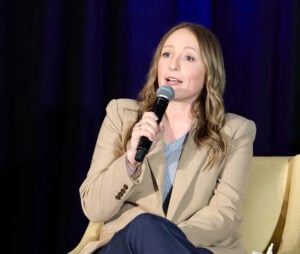
Natalie Collins, President, CAWG
“The mentality in the wine grape industry is that a rising tide lifts all boats,” Collins says. “Let’s all put our hands in to make it better for everyone.”
Built for This Work
Collins didn’t land in wine grapes by accident. She grew up in agriculture; her family in the dairy industry. She was the kind of kid who gravitated toward 4-H (a national youth development organization run through the USDA’s Cooperative Extension System) and FFA (Future Farmers of America). She earned a B.S. in agricultural business with a minor in organizational communications from Cal State Chico, then cut her teeth at the San Joaquin Farm Bureau before joining CAWG a decade ago.
Growing up in Lodi, one of California’s largest wine grape regions, with over 80,000 acres of wine grapes, Collins was raised in this industry. She was studying it long before receiving any sort of formal diploma.
“It’s an industry I’m very passionate about,” Collins says, “mostly because of the people in it and how forward-thinking and progressive they are: wanting to do things right through sustainability programs, how they treat their workforce, and building communities.”
The people-first instinct defines how Collins leads. She was appointed CAWG president in late 2022, and her approach has been consistent: listen to growers, bring their real-world problems to the right tables, and push for solutions with data, not hypotheticals.
Building a New Safety Net Together
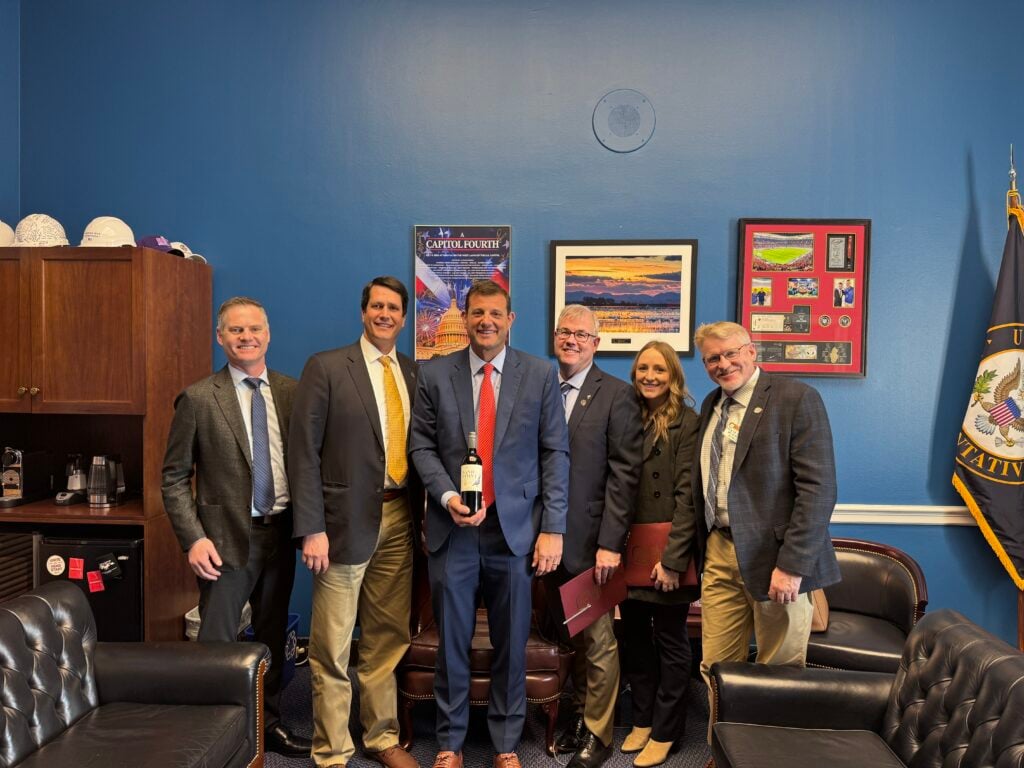
California wine grape growers and CA Congressman David Valadao.


The wildfire smoke endorsement is the clearest example of what happens when an industry organizes around a problem instead of just absorbing the damage.
In 2017 and 2018, California’s wildfire seasons revealed something the state’s wine industry hadn’t fully reckoned with: smoke itself could destroy a crop. Volatile phenols, which are chemicals carried in wildfire smoke, land on grape skins and seep into the fruit. When those grapes go through fermentation, the resulting wine can taste, as Collins describes it, like an ashtray. Wineries started rejecting fruit. Growers with valid contracts suddenly had no buyer.
The old crop insurance framework didn’t have a clear answer. So CAWG built one.
They funded research to establish measurable thresholds for smoke damage. They brought real grower stories to the USDA’s Risk Management Agency. And they proposed a new endorsement modeled on the Hurricane Insurance Protection – Wind Index Endorsement used in hurricane-prone states, a product that triggers automatic payouts when conditions exceed defined thresholds.
The result is the Fire Insurance Protection – Smoke Index, or FIP-SI. It attaches to the standard grape crop insurance policy and triggers when a county experiences more than 13 heavy smoke days between June 1 and November 10, Collins explains. It launched as a pilot in California for the 2025 crop year and has since expanded to Washington, Oregon, and Idaho.
“I don’t think it’s perfect,” Collins says. “But we really appreciate the Risk Management Agency working with us to find a solution.”
That candor is the point. CAWG isn’t selling silver bullets. They’re building incrementally, with real data, alongside a federal agency that Collins describes as genuinely open to collaboration. And the product they helped create is now protecting growers across four states.
Growers Getting Smarter About Coverage
One of the more encouraging shifts Collins sees is how strategic growers have become about their crop insurance.
Where a grower might once have gone with a standard coverage level across the board, today they’re examining every vineyard block individually, factoring in historical frost frequency, contract terms, and location-specific risks.
“For example, the grower may say, this vineyard over here, in the last 20 years, has gotten frosted eight times,” Collins explains. “The one over there hasn’t at all. They’re being much more strategic to ensure that if an insurable loss does happen, they are covered to their best extent.”
That precision matters. Collins pushes growers to think beyond crop insurance, too, to look holistically at diversification, workforce stability, regulatory compliance, and budgeting. But she’s clear that crop insurance is the foundation.
“If fruit is rejected at harvest for any given reason, and you did not have crop insurance, you essentially aren’t getting a paycheck for the year,” she says. “Those situations should not occur in agriculture.”
Fighting for “American” on the Label
CAWG’s work isn’t limited to insurance. Right now, Collins and her team are co-sponsoring Assembly Bill 1585 in the California legislature: a truth-in-labeling bill that would require wine sold in California under an “American” appellation to contain 100% American-grown fruit.
Under current federal rules, a bottle labeled “American” can legally contain up to 25% foreign fruit. AB 1585 would close that gap.
Collins is clear-eyed about what the bill can and can’t do. “If we are successful, it is not going to change the supply and demand dynamics overnight,” she says. But it’s given growers across the state something concrete to rally behind. It’s the collective energy that matters.
“It’s one small example of growers feeling like they’re part of the fight for change,” Collins explains.
The bill has already passed its first committee and has broad industry support. It’s the kind of tangible win that reminds growers they have a voice and that using it together can move the needle.
The Headwinds Are Real But So Is the Response
None of this is happening in a vacuum. The California wine industry is navigating a genuinely difficult period. U.S. alcohol consumption has dropped to a 90-year low. Younger generations are drinking less. The competitive beverage landscape has exploded. And emerging factors like GLP-1 weight-loss drugs are showing measurable impacts on wine consumption specifically.
Collins doesn’t minimize any of it. She calls the current moment “death by a thousand paper cuts”; a convergence of pressures unlike anything the industry has faced before.
But the story she keeps coming back to isn’t about an industry in turmoil. It’s about the response. Growers showing up to board meetings. Emailing daily with questions and ideas. Testifying in Sacramento. Funding research. Refining their coverage. Fighting for policy changes that protect domestic production.
“I am not responsible for coming up with every idea or solution to every problem,” Collins says. “It is growers who are living it day in and day out that are putting in the work.”
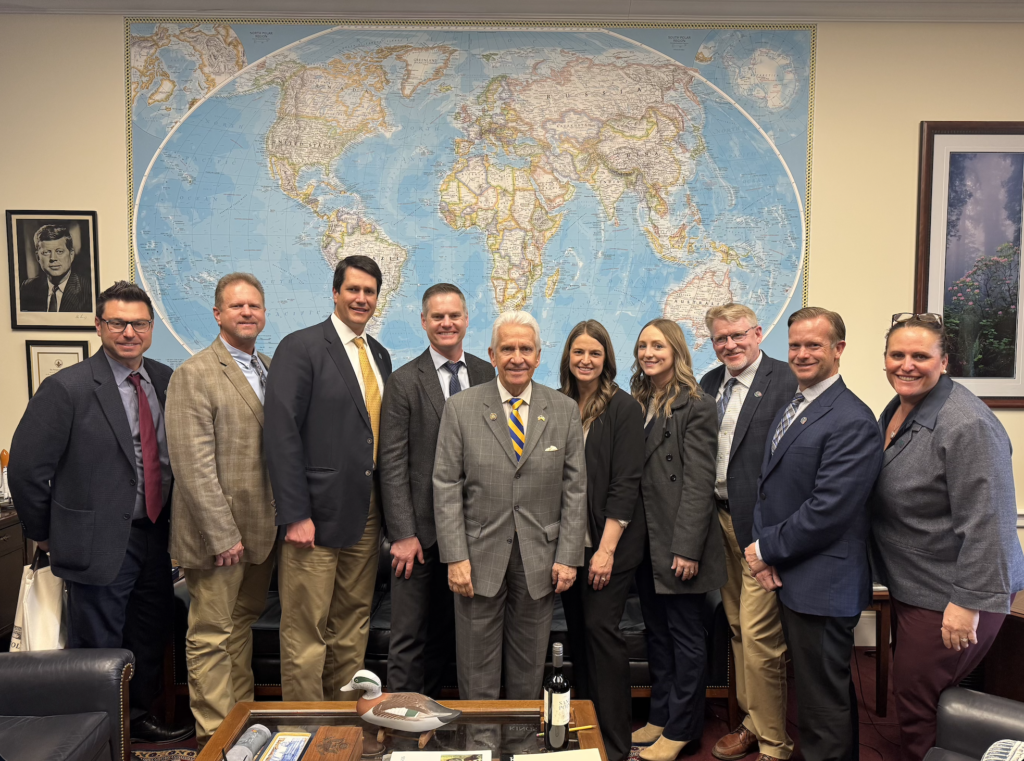
California wine grape growers with CA Congressman Jim Costa.
A Blueprint Worth Watching
California’s wine grape industry is a proving ground for every specialty crop grower in America. The challenges hitting this sector, like climate volatility, shifting consumer behavior, regulatory complexity, aren’t unique to wine. Similar realities are confronting tree fruit, citrus, berries, and every other high-value crop.
What CAWG is doing, bringing data-driven proposals to the RMA, pushing for index-based endorsements, advocating for labeling standards that protect domestic growers, reflects the growing need for specialty crop industries to rethink how risk, market disruption, and long-term sustainability are addressed.
And the way they’re doing it matters as much as what they’re achieving. Not top-down directives from an industry association. A collaborative push where growers, researchers, and federal agencies are working the problem together.
That’s the real story here. Not an industry in crisis. An industry that rallies.
Natalie Collins is President of the California Association of Winegrape Growers (CAWG), where she leads advocacy efforts on behalf of California’s wine grape industry. She can be reached at natalie@cawg.org. We extend our gratitude to Natalie for sharing her insights and experiences with Insure.ag, our growers and the broader community.